2025 ‧ Dystopian Coming of Age/Horror ‧ 108m
The third major Stephen King adaptation of the year comes to us from Francis Lawrence, the director of the Hunger Games sequels and prequels. Another story about young people in a fatal competition.
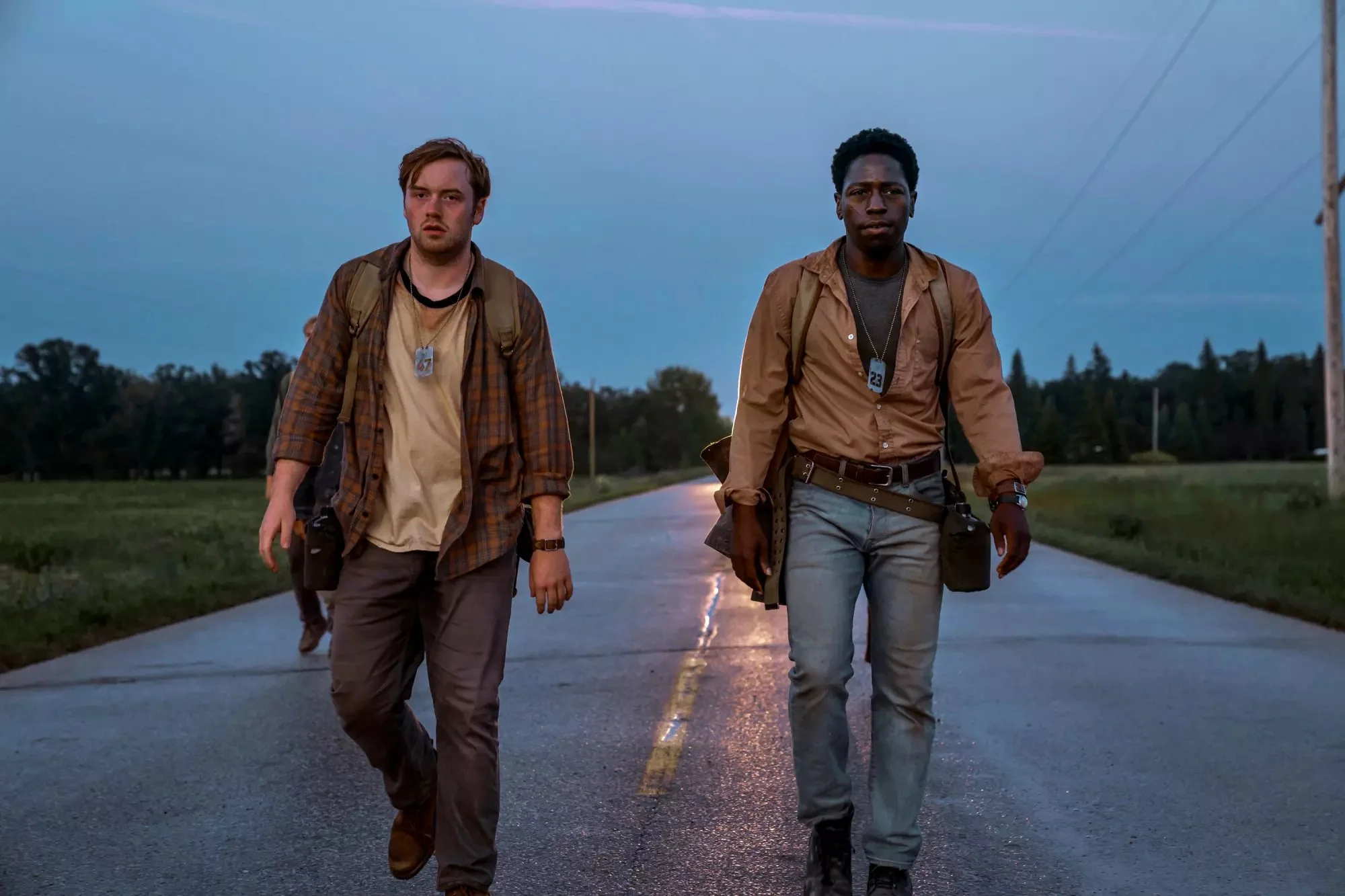
Set in a totalitarian America after a devastating war, The Long Walk follows Ray Garraty and his experience in the titular contest. One teenage boy from each state is chosen to compete from hundreds of volunteers. They must continually walk on a paved road for miles and miles, keeping an average speed of 3 miles an hour. If a walker slows down below that threshold, they get a warning. The warning can be erased by walking an hour at the set rate. Get three warnings, and the walker will “get his ticket.” Meaning he will be executed by the soldiers following the walkers. The last one walking will win a hefty cash prize and one wish of his choosing. Ray quickly makes friends with three other walkers: Hank Olson, Art Baker, and Pete McVries. The four help each other out often during the walk, but in the end only one can win.
When Suzanne Collins’s The Hunger Games was first published, there were many accusations that she plagiarized from the Japanese film and novel Battle Royale. There are indeed similarities, but that was not the case. Stephen King seemed to be the biggest influence on her concept. Collins’s book meshed the ideas of two of King’s Richard Bachman novels, The Long Walk and The Running Man. King himself even had a quote praising The Hunger Games on the paperback edition. Having Francis Lawrence helm this adaptation, with all his experience in Collins’s dystopia, makes a lot of sense. Making a film of The Long Walk has been attempted several times since the book’s debut in the 1970s. Many directors had been trying to adapt this for decades. Most famously George A. Romero and the great King adaptor Frank Darabont. Lawrence may not have the legendary status of those directors, but he certainly has the right skills for the job.
Lawrence had been confined to PG13 violence in his previous YA films, here he leans hard into the R rating. The walkers are dispatched in brutal, graphic, and visceral ways. Early in the film, Ray and Pete have a haunting exchange after the second or third death: “I hope that gets easier,” “I hope it doesn’t.” As the film progresses, it does not get easier. The bond of the characters becomes so strong each death has an emotional resonance. Even the more supporting roles. Lawrence reportedly made the smart decision of shooting the film in sequence. And when a character died, the actor went home. This builds authentic bonds in the cast. All this young male bonding makes the film feel like a dark inverse of another King adaptation, Stand by Me.
The film is quite literally a lot of talking and walking, with regular bursts of violence. For this to work the ensemble must quickly connect with each other and the audience. Cooper Hoffman as Ray and David Jonsson as Pete quickly become the central relationship of the film and watching them bond is quite endearing. This performance is something quite special, and one of the main reasons to watch. It is the central friendship that anchors the film and informs the additional bonds the two have with the other walkers. Tut Nyuot as Baker and Ben Wang as Olson are great at complementing the central duo, but they also give the characters a full personas. Charlie Plummer as the misanthropic Barkovitch and Garrett Wareing as Stebbins are fantastic foils. Judy Greer stands out, as always, in the few scenes she has as Ray’s mother. Mark Hamil, as the imposing leader known as The Major, might skirt toward caricature, but the character himself is somewhat larger than life and cartoonish. His years of voice work serve him well here. Fans of the original novel may balk at some of the changes screenwriter JT Mollner made in his adaptation. However, each choice to deviate makes for a stronger story here in the film.
Horror films, though this may barely qualify, often process the fears society is experiencing. King very much was writing about the Vietnam War when the original book was written. That war aspect is present in Lawrence’s adaptation, but so is the looming threat of fascist authoritarianism and the ever presence of gun violence. Lawrence and King are not trying to exorcize these fears, but to help audiences sit with them and perhaps find some catharsis, if only short lived. The Long Walk is a tragic and bleak film, one that audiences may have difficulty watching. It is layered in such a way that once they get passed the horror, viewers will be rewarded with many themes and ideas to ponder.
One hopes for a time when this film feels less relevant.
Grade: B+
~Andrew
For the reviews of the other 2025 Stephen King films, click HERE for The Monkey
and HERE for Life of Chuck.