Sorting Through the Best Pictures: 1980-1989

Oh, the 80s. Heyday of new wave, Reagan, and embarrassingly large hair. Despite there being some truly great audience favorites during this decade (Ghostbusters, Back to the Future, Indiana Jones etc.), stuff at the Academy wasn’t as great. Let’s take a look.

1980-1989

“Really? This was ‘the Best?’”

Out of Africa (1985)

I know I’ve talked about how awesome Meryl is in the 70s post, but really she is the only reason to watch this. She gives one of her best performances in an overlong, well-shot, but very dull film about a love affair on an African farm. Redford is good too, but he doesn’t make the film anymore interesting. I’ve joked about there being an “Academy Award” genre, and I think this held the top title of said genre for a bit. Grade: C+


Driving Miss Daisy (1989)

This movie isn’t awful, which a lot of folks may lead you to believe. It is extremely schmaltzy and frankly too nice. When you consider that was against other nominees like Dead Poet’s Society and Born on the Fourth of July it seems a weird choice. Even stranger when you consider that this was nominated and Do the Right Thing and Glory weren’t. It’s mostly just okay, a movie you’d watch with your grandmother on a Sunday afternoon. Grade: B-

The Good
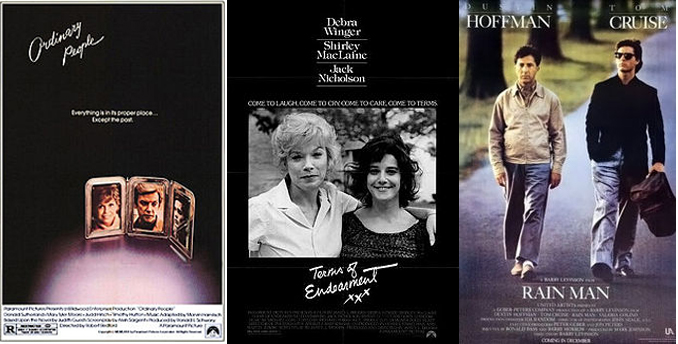
Ordinary People (1980)

Folks tend to dislike this flick due to the fact it beat Raging Bull. True, Marty’s pugilist drama is superior in a lot of ways and is probably the better film, but Redford’s family drama doesn’t deserve all the hate. Mary Tyler Moore plays amazingly against type, and that alone I think is worth watching. It has an ending that bothers people, but I think its what makes the film work. Grade: B


Terms of Endearment (1983)

Another family drama, though also pretty funny. Weirdly, I think the best way to describe this is “a Texas Mother/Daughter story about searching for love.” That doesn’t quite do it justice, but you get the idea. Jack Nicholson plays a retired astronaut. Not something you see everyday there either. I liked it a lot actually, though I felt it could be tightened up editing wise. Furthermore, I don’t know if it is  a better film than the also nominated The Big ChillGrade: B


Rain Man (1988)

Another Sunday afternoon with your grandma kind of flick. This is one of those films that penetrated the culture so much it got parodied to death. Tom Cruise discovers he has a long lost autistic brother in Dustin Hoffman and they travel across the country. It is fun and hits all the right notes, but I can’t help but feel it isn’t quite great. Grade: B

The Great

Platoon (1986)

Maybe not the greatest Vietnam movie, but certainly up there. Oliver Stone’s tale does not let us forget that war is Hell. Said Hell is not just the regular horrors of war, but also the other soldiers in your unit. Willem Dafoe and Tom Berenger are so good that I think people forget Charlie Sheen is in the flick. Johnny Depp too. I’m still not much for war pics, so I probably will never need to see this again, but I’m glad I did. Grade: B+


The Last Emperor (1987)

Actually filmed in the Forbidden City, Bernardo Bertolucci tells the story of Puyi, China’s last emperor. It’s an interesting story both biographically and politically. The film's cinematography is examplary and the performances are outstanding. I really dug the score too. It might be a bit long, and a even longer version exists. Grade: A-


The Essential

Chariots of Fire (1981)

Cards on the table, I ran track in high school, so this might mean more to me than others. I imagine for some it’s just a stuffy flick about Brits running. Okay, it is that, but it's amazing how engaging and interesting it is considering all that. Inspiring and legendarily scored (you know the theme even if you don't realize). If this film doesn't make you wanna get up and do something- you might be dead. Grade: A-


Gandhi (1982)

The biopic to end all biopics. Ben Kingsley gives a performance I don’t think he has quite topped. This is one of the few 3 hour films that I don’t mind being 3 hours. Though I am a bigger fan of the also nominated Tootsie, this was clearly the better film. Grade: A


Amadeus (1984)

Perhaps not the most accurate period drama, Amadeus makes Mozart seem cool. Part of this is Tom Hulce’s superbly manic performance, the rest is the story itself. In one of the most bizarre and strange acts of revenge ever, F. Murray Abraham as rival Salieri attempts to drive Mozart insane. This might be the most entertaining film of the Academy Award genre. It's trailer is one of my favorites. Grade: A

See you on Tuesday for the 90s!
Sorting Through the Best Pictures: 1970-1979

The 70s. The "Me" decade of Watergate, disco, and the end of the Vietnam War. This was when the New Hollywood era really peaked and started to be taken more seriously. There were bad flicks, of course, but this decade doesn’t have a winner that I felt belonged in the “Really? This was ‘the Best?’” category. All of the winners really were exceptional films.


1970-1979

The Good

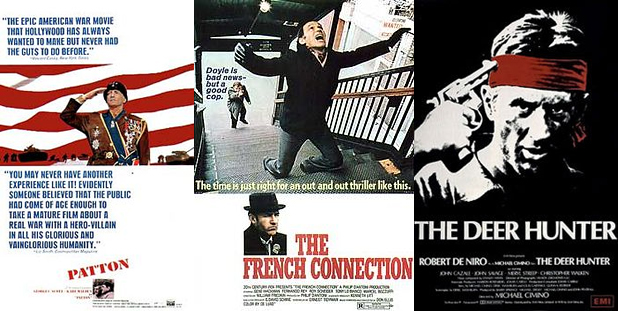
Patton (1970)

Though still fatigued by WWII films, I can see why people dig this flick. Penned by Francis Ford Coppola and masterfully performed by George C. Scott, the film has quality all over it. A biographical war film, we get to see the war from Patton's perspective, which is larger than life. It's a bit long, but it is well made. When it comes to war flicks from 1970, I’m more of a M*A*S*H* guy than Patton. Grade: B


The French Connection (1971)

Being a fan of gritty crime dramas, I was really looking forward to finally sitting down and watching this whole film. Though Hackman as Popeye Doyle is engaging and the overall style of the film is great- I just didn’t quite get into the story like I thought I would. It’s still good, but not as great as I thought it would be. Still, the film has possibly the best car chase in cinema history. Grade: B


The Deer Hunter (1978)

Like I said earlier, this feels like the Vietnam answer to The Best Years of Our Lives. It's gut wrenching and hardcore, but it could probably have a good 45 minutes of “pre-war” cut. De Niro and Walken might be the strongest of the ensemble, but Meryl Streep does what Meryl does- be awesome. Her part isn’t very big and that is a pity. Grade:  B-


The Great

The Sting (1973)

There aren’t a lot of “delightful” crime features, but this is probably the best one. Newman and Redford and joined together again by their Butch and Sundance director. I wonder how many people only know Scott Joplin music because of this movie. Though there is a lot of “old Hollywood” in this film and that might be why the Academy picked it over the possibly better nominees The Exorcist and American Graffiti. Still, it’s one of the few best picture winners that can easily be described as "fun." Grade B+


Kramer vs. Kramer (1979)

This won against All that Jazz, which is possibly the best movie musical ever. So I was kind of prepared to be unimpressed, but you know what- it’s a pretty great flick. Possibly Hoffman’s best performance. Though audiences were introduced to Ms. Streep the year before in The Deer Hunter, this is the beginning of the Meryl we all know and love. Something I really dig about this flick how well it can work without dialogue. Those sequences really show the craft of film making and acting. Grade: B+


The Essential

The Godfather (1972)

The Godfather Part II (1974)

These films, like Gone with the Wind and Casablanca, have had a lot written about them and you don’t need me to tell you that they are essential. Seriously, they are two of the greatest films ever made. I am one of those who thinks the second is better than the first, there are a number of us. Anyway, this is how you do a saga. I do come from an Italian family, so I guess this gets to me on that level and may not on others. If you think of yourself as a lover of film, or have just a passing interest- these are required viewing. Grades: A- (Part I), A (Part II)


One Flew Over the Cuckoo’s Nest (1975)

This movie might run the gamut of emotions. It’s funny, horrifying, inspiring, depressing, etc. This is one of those rare moments where everything works out. Nicholson gives what is probably his best performance as McMurphy and Louise Fletcher as Nurse Ratched will haunt your nightmares.  Grade: A


Rocky (1976)

Not only did I watch all the Best Pictures last year, I also watched all the Rocky films. In 2015 Creed came out and I couldn’t remember if I had see all of the Italian Stallion’s entries, so I watched them in reverse order. I do not recommend this. The last five minutes of the previous entry is the first five of the next. Anyway, I’ve become a bit of a Rocky fan. So here’s the thing about 1976, everything up against Rocky was stellar: All the President's Men, Bound for Glory, Network, and Taxi Driver. I think any of them could’ve won and it would have made sense. What makes Rocky so essential? It would create the blueprint for sports and underdog films for the next 40 years, and it’s also a great movie. It might not be asking the hard questions like All the President's Men and Network, or have the haunting performances and direction of Taxi Driver, but its influence would change the language of film. Grade: A-


Annie Hall (1977)

This has gained some controversy over the years because it beat Star Wars, and that isn’t unexpected. Though a great film and an essential Woody Allen film, Annie Hall doesn’t have the cultural impact of the space opera. No one gets excited about a new Annie Hall action figure complete with lobsters. Well, maybe I would. What makes this essential is that it isn't just a rare comedy to win, but one of the best screenplays ever. It is, like most Allen films, super self absorbed, rambly, and some of the social norms haven’t aged well- it is a product of it’s time, but it is also hilarious and superbly structured. I don’t think this is Allen's best, that is probably Crimes and Misdemeanors. Even so, Annie Hall is a wonderful time. Grade: A-


On Thursday we'll grapple with the 1980s. See you then.

Sorting Through the Best Pictures: 1960-1969

Into the turbulent 60s. Though musicals really develop into something great in the 50s, the 60s may have had too many. Of the 10 winners, 4 were musicals. I think this tells us something about the 60s. Times were uncertain, so it makes sense that escapism would reign in entertainment for a bit. Not that all these musicals could be considered solely “escapism,” but I do think they weren’t quite asking the hard questions that later winners in the 70s would. This was definitely the decade where "Old Hollywood" was shifting to "New Hollywood."

1960-1969

“Really? This was ‘the Best?’”

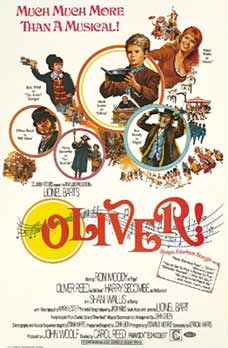
Oliver! (1968)

This is sorted here for a couple of reasons. 1- 1968 was a pretty great year for cinema and this movie just pales in comparison to films like the (also nominated) Lion in Winter and the (not nominated for Best Picture) 2001 and Battle of Algiers. Shoot, screenplay winner The Producers might be a better musical than this and that had maybe two songs. 2- Though the songs, the performances and even the musical itself isn’t bad, I just didn’t find this very interesting. It somehow makes 2 and a half hours feel like 4. I suppose it should be noted that my first exposure to this Dickens tale involved Billy Joel and Cheech Marin. “Why should I worry?” Grade: C


The Good

West Side Story (1961)

Robert Wise had an extremely varied career. In addition to being Citizen Kane’s editor, horror helmer of Curse of the Cat People and The Haunting, and the man behind the sci-fi classic The Day the Earth Stood Still- he also has some well made musicals under his belt. Wise’s adaptation of the popular Sondheim/Bernstein take on Romeo and Juliet is solid and archetypal. I have always felt though that it is missing some of its bite in the film version. Or perhaps I’ve usually encountered grittier interpretations of the stage version. It’s a good flick, if a little cheesy when viewed now. Grade: B-


Tom Jones (1963)

I’m not sure how to classify this movie. I think it is mostly a comedy, I mean I laughed a lot and it is kind of zany at times. It’s also an adventure film and a bit of a lusty romance. It’s kind of bizarre and I think that’s why I like it, though most of the people involved in the production seemed to think it wasn’t so good. Director Tony Richardson would trim 7 minutes from the film when he made his cut years later- and maybe that is for the best as the film does seem a little long. It took some digging to find the original theatrical cut of this, but I found it. I dug this more than I thought I would, however I think a lot of folks would be probably confused why this won anything. Grade: B


The Sound of Music (1965)

Okay, before I get to it, I gotta level with you- I kind of hate Rodgers and Hammerstein musicals. So keep that in mind. Another Robert Wise joint with great photography, color, and an iconic performance from Julie Andrews (not to say anything of Christopher Plummer). Too bad it’s filled with songs I can’t stand and that makes me feel every minute of its three hours. But I know that a lot of people love this film because of those songs, so I’m willing to admit my bias on that. I think this will always disappoint me because it is the only time in history that a musical could have gotten away with dancing nuns and nazis. Rolfe doesn’t really dance much, so don’t give me that argument. The film is well made and despite my bias, I probably would have voted for this in ‘65 too were I there. Grade: B


A Man for All Seasons (1966)

Given my cinematic leanings, I should think “Shark’s in the water. Our Shark.” when I think of Robert Shaw. Nope, I think “Do they take me for a simpleton?” Not sure how a little quote like that won out in my brain, but it did and it's from this flick. The story of Thomas More and his clash with King Henry is more interesting than it should be- mostly because every performance is top notch. However, I think the also nominated Who’s Afraid of Virginia Woolf? Is a better film. Grade: B


The Great

The Apartment (1960)

An unusual romantic comedy. Jack Lemmon owns an apartment that his bosses use for affairs. One night Shirley MacLaine attempts suicide in the apartment and Lemmon finds her. I assure you it’s funny. Director Billy Wilder sort of specialized in these seemingly light comedies with a streak of darkness. Though I am a big fan of this film, it probably could be a little tighter. This is essential Wilder if not quite essential Oscars. Grade: A-


My Fair Lady (1964)

The musical adaptation of a George Bernard Shaw classic, My Fair Lady is a delightful film with songs that everyone knows, even if you don’t know where they came from. I was a fan of the original Shaw play, Pygmalion, before I watched this. Though the performances are great: Audrey Hepburn at her most marvelous, Rex Harrison at his douchiest- The changed ending of this from Pygmalion taints the film for me. Grade: B+


In the Heat of the Night (1967)

This is in need of reexamination right now. The story of a black northern cop caught up in a southern murder case seems timely again. Maybe it was never untimely. The crime drama is really tight and enthralling. Though other nominees The Graduate and Guess Who's Coming to Dinner? might be better remembered now, I can see why this won out. Grade: B+


The Essential

Lawrence of Arabia (1962)

Bare in mind that the first time I completely watched this was on a regular size screen and not in the cinema and that seems to make a difference. Even on a smaller screen this epic of T.E. Lawrence is still spectacular. This may very well be the best shot film in history. I lament I didn’t see it in the cinema. Well shot and all though, I still felt kind of disappointed. There’s a lot of hype about this film and when I finally finished it, I could help but feel like “that’s it?” I didn’t really have that feeling with Gone with the Wind or Casablanca. If I were to go back in time, I would make To Kill a Mockingbird Best Picture and give Best Actor to Peter O’Toole. No offense to Gregory Peck there, it’s just that big Pete gives the performance of his life and I always felt that Peck in Mockingbird got it more for legacy reasons and it would be hard not to win for the role of Atticus Finch. My quibbling aside, if you can see this in a cinema- go do it. Grade: A-


Midnight Cowboy (1969)

Often just a footnote for being the “X-rated” winner (since amended), Midnight Cowboy is probably the most 60s film of all the winners. This gritty, at times naive, uncomfortable story of a hustler in New York really gets under your skin. Not the easiest film to watch, and certainly dated, it’s worth watching just for Dustin Hoffman as Ratso Rizzo. Grade: A

Tune in Tuesday for the 70s!

Sorting Through the Best Pictures: 1950-1959

Onward through the 1950s! The first real era when television was a force to be reckoned with. Because of the small screen, the big screen got bigger and more spectacular. Musicals really came into their own in this decade. Color and wide aspect ratios would soon take over. However, that doesn’t mean smaller black and white films stopped. In fact, I think they may have increased in quality during the 50s. Let’s take a look.

1950-1959

“Really? This was ‘the Best?’”


Greatest Show on Earth (1952)

    What should be a compelling and entertaining tale of the circus, is actually a bloated, somewhat boring mess. You can tell this was a “big deal” kind of flick: directed by Cecil B. Demille, a lot of top stars, over two hours, and lush color. For some reason, none of that really works.  There are two stories going on in this film- a narrative about people in the circus, and documentary like footage of circus acts. If there was less of the latter it would be a more worthy entry. Though, to be fair, the circus folk narrative isn’t particularly amazing either. No way is this a better film than the also nominated High Noon or The Quiet Man or the not nominated Singin’ in the Rain or The Bad and the Beautiful. I’m not really sure why this won out. Demille’s non-opus and Broadway Melody are, in my opinion, the bottom of the Best Picture barrel. Grade: D+


Around the World in 80 Days (1956)

    I liked this movie as a kid, but now that I’ve reevaluated it, this flick could probably have an entire hour cut from it. Most of that footage would be uninspired “travelogue” shots. I’m a pretty big fan of David Niven, and to me he is Phileas Fogg. Niven does his best to keep the momentum going in a cameo laden opus, but at 3 hours, that is difficult to do. Grade C+


The Good


Marty (1955)

    Yes, it’s just the small story but it is told in such a way that it seems bigger. Ernest Borgnine stars as the titular Bronx butcher in this romantic drama. The film is often forgotten in Oscar history, which is a bit of a shame. I think if you dug Silver Linings Playbook, you’ll probably like Marty. Grade: B+


Gigi (1958)

   A few weeks after I watched this, I went to see La La Land. Which I think enhanced both films. I was actually dreading watching this one, it struck me as one of those kind of musicals that would require insulin shots after watching. I liked it more than I expected. The story of the romance of Gigi and Gaston is told in lavish color and great cinematography. However, the song “Thank God for Little Girls” has not aged well at all. Grade: B


The Great


American in Paris (1951)

     Another film enhanced by seeing La La Land around the same time. I still think Singin’ in the Rain is better film, but American in Paris is a pretty solid movie musical. Gene Kelly in near top form with great songs. Seriously, the dancing is some of the best ever filmed. A good time indeed. Grade: A-


The Bridge Over River Kwai (1957)

    WWII again. I will say I wish there were more war films like this, there is an odd sense of “adventure” that other war films of the period are missing. There was a great sense of suspense even though you pretty much know how everything is gonna pan out. I feel like this film makes interesting remarks about the difference between the Brits, the Americans, and the Japanese at the time. It made me realize just how quintessentially American William Holden could be. Grade: A-
 

The Essential


All About Eve (1950)

First film to be nominated for 14 awards and probably one of the best films about rivalry and relationships. It deserves all its praise. This story of two actresses and how they affect each others lives sticks with you for a long time afterward. I do know some folks that don’t like this flick because of that reason. I don’t think they are wrong, the film certainly leaves an impression- all because of how well it was written, directed, acted, and produced. Grade: A


From Here to Eternity (1953)

    Like Mrs. Miniver, this is a “war” movie that isn’t really about the war. It's a story of soldiers stationed in Hawaii just before December 7th. This is another one of those often referenced films, with the beach makeout scene lampooned particularly well in Airplane! More a domestic military drama than a war film, every actor in this film gives it their all. All the principals were nominated and Frank Sinatra and Donna Reed won their categories. An interesting look at the beginning of a dark time. Grade: A


On the Waterfront (1954)

    Brando, man. This crime drama of dockworkers really is one of the greatest films of all time. Like most films of that caliber, it has been parodied to hell. How many folks know the “I could’ve been a contender” scene without really knowing this film? It’s a bit of a shame because the power of that scene has almost been diminished because of it.  Almost, thankfully. If you haven’t actually sat down to watch this, I recommend you do soon. It is director Elia Kazan’s masterpiece. Grade: A
 

Ben-Hur (1959)

    There are two epic films to end all epic films, in my opinion: this and Lawrence of Arabia. Though this film is approximately 4000 years long, I never grew bored or disengaged. This film is spectacle at its highest without being overindulgent somehow. I also like the somewhat disputed claims of homoerotic subtext between Massala and Ben-Hur. Partly because it pissed Charlton Heston to no end, but really because it gives an interesting wrinkle to the story. I’m fairly sure Massala's Stephen Boyd played it that way too. I don’t know why anyone thought it was worth it to remake this last year. Grade: A

Come back Thursday for the 60s!

Sorting Through the Best Pictures: 1940-1949

Let's continue the journey through the Best Picture winners into a really solid decade. To me, with the exception of maybe 1939, the 1940s were the apex of the Golden Age of Hollywood. Some true classics came out of this era and there are some years that all the nominees are worth watching.


1940-1949

“Really? This was ‘the Best?’”


How Green Was My Valley (1941)

Going My Way (1944)

    Okay, unlike the previous entries in this category, these aren’t bad movies really. They are being sorted here because there were way better films that should have won instead. Going My Way is a nice little musical about Bing Crosby as a priest in New York with fine tunes and good performances, but is it really better than Double Indemnity? Though, I do admit that Billy Wilder’s noir classic is in my top five favorite films of all time. How Green Was My Valley also isn’t a bad film by any stretch of the imagination, but it really isn’t better than Citizen Kane. I get why Kane didn’t win, in a political sense I suppose, but the also nominated Maltese Falcon is better than Valley too. Valley however, being the plight of Welch miners is about as “Academy Award” as it can get without being The English Patient.

Grades: B (for both)


The Good


The Lost Weekend (1945)

    This film’s win kind of gives credence to my whole Double Indemnity over Going My Way argument. It’s like the Academy was like, “Yeah, we did bad last year, sorry about that.” Weekend was also helmed by Wilder (who also won Best Director, having lost the previous year). This saga of an alcoholic trying and failing to stop became the blueprint for "problem" pictures. What seems cliche now, wasn't quite back in 1945. This film isn’t bad really, Milland’s performance is engaging if a little Cage-esque, but it sure comes off as annoyingly preachy toward the end. Grade: B 


Gentleman’s Agreement (1947)

    This is preachy too and much more hamfisted when viewed today. Even so, it is a pretty good film, and Gregory Peck just knocks it out of the park. It’s a good story of racial prejudice and anti-semitism, but you can’t help but feel that the kid gloves are on. Also there is something icky about Peck pretending to be Jewish for a newspaper column. But maybe that ickiness adds something. Grade: B+


Hamlet (1948)

   There's a chance I rated this higher because I’m a bit of a Shakespeare fan. I like alternative retellings more (Scotland, PA being my favorite), but this dreamy ethereal adaptation is quite interesting. I really dig the set design Olivier used. Something about the open space and the fogginess really works with Hamlet. Also everybody puts in amazing performances, albeit in typical "Shakespearean" ways. If you aren’t into Big Bill or the Prince of Denmark, this will be a chore. But if you have even the slightest interest, you’ll like it. Grade: B


The Great


Rebecca (1940)

    Hitchcock’s only Best Picture winner is from an extremely stellar year. Most of the best pic nominees that year are classics in their own right, but I can see why this won out. One of the best Gothic romances ever, and Hitch's second of three Daphne du Maurier adaptations. The story of an unnamed woman who marries a widower aristocrat, and how he and everyone in the house is haunted by his late wife. Like every Hitchcock film, I notice something new every time I watch it. It isn’t Hitch’s best work, but it is better than Foreign Correspondent, Hitch's other film nominated that year. A ghostly, great film. Grade: A-


Mrs. Miniver (1942)

    I confess that I am super burnt out on WWII films. I was burnt out before I started watching all these films, and after this exercise I’m probably gonna be burnt out for a few years at least. I think what made me like this was the fact that it focused solely “at home.”  A domestic drama foremost, but it’s definitely a war film. The British setting also makes the stakes higher, as an air raid could happen at any minute. My favorite aspect of the film, without giving too much away, is that it goes the other way with a certain expectation. Not so much a twist, but a better way to tell the story. You’ll have to see it to know what I mean. Grade: A


All the King’s Men (1949)

    I’m glad I watched this during an election year, but it is still pretty relevant in general. The rise and fall of a rural politician isn't anything new, even back then, but it's a story that needs retelling from time to time. Basically the thesis of the film could be boiled down (albeit cynically) to “This is how populism works.” If you haven’t seen it, watch this with the similarly themed Face in the Crowd. Grade: B+


The Essential


Casablanca (1943)

    You’re not surprised about this, are you? Okay, I must admit that until last year I hadn't sat down to watch the whole thing. I knew the story well, and had seen all of it in bits and pieces. You probably know the story about Rick, his bar, and his lost love that returns- all the while dealing with Nazis. Even with that knowledge and the fact that this is one of the most referenced films ever, I was transfixed. Though a WWII film, it never really feels like a war film like Miniver does. Possibly the most essential title you will encounter in all the winners, and it totally lives up to its hype. Grade: A+


The Best Years of Our Lives (1946)

     An ensemble drama of veterans returning home. Harold Russell gives one of the greatest performances in the history of acting as a double amputee. Overlong yes, melodramatic for sure, but still essential. It would become the template of all “back from the war” dramas. In a lot of ways The Deer Hunter is just the Vietnam version of this. Despite it’s flaws, the performances and the epic closeness of the story are just classic. Grade: A- 

See you guys next Tuesday for the 1950s!


Sorting Through the Best Pictures: 1927-1939

 Being a film buff and a bit of an Oscar nerd (they are my Super Bowl), I spent 2016 watching and reviewing all the best picture winners. One does not watch 87 movies without noticing some things. What is considered the "best" from year to year is an interesting concept. Some were obvious, others… not so much. With this year's nominees being announced today, I figured it be a good time to sort through the lot. Most internet folks are into ranking, and when I started the project I thought about doing that too, but I instead found myself placing them in categories of quality: “Essential,” “Great,” “Good” and “Really? This is the Best?” So that is what I’m going to do here. Decade by Decade. Every Tuesday and Thursday until the Oscar ceremonies.

1927-1939

“Really? This was ‘the Best?’”

My “Really? This was the Best?” category has more entries in this era than in other decades. Some of that is due to the Academy's infancy, but really the early days of the Oscars were not that different from today. Some movies won out for what I can only assume are “just because” reasons, instead of actual merits of quality. That still happens, but this first period has a lot of egregious examples. Flicks in this category are generally not so great. However, in some cases, these won out over much more deserving films.

The Broadway Melody (1928/29)

  The second ever Best Picture winner and I can really only justify its winning with “best utilization of the medium of sound.” I guess it has interesting musical numbers, but it was quite hard to find it at all interesting in a 2010s mindset. Honestly, it’s a bit of snoozefest and the love story seems trite even for the 20s. A definite contender for the worst of “the best.” Grade: D+

Cimarron (1930/31)

This failed epic must have won due to its grand scope concerning westward expansion and such. It’s based off an Edna Farber book, which explains its aspirations, but this certainly has failed the test of time. It comes off as racist and kind of boring, especially when compared to later westerns. After watching, I felt that this was just a film that tried to be something bigger and did not. The Front Page (also nominated that year), is a better, if smaller film. Grade: D

Cavalcade (1932/33)

    Once again, I think this won for being the “biggest” movie of that year. Based on the Noel Coward play, which I read before viewing, the film is about the history of two families, the Bridges and the Marryots. We see major historical events (like the sinking of the Titanic) through their eyes. It's an interesting idea and is a fine adaptation of its source, but like its source, is extremely stagey and dull. I can’t help but feel that year's I Am a Fugitive From a Chain Gang or 42nd Street were better films. Grade C-

The Great Ziegfeld (1936)

    Another “big” movie that wasn’t the best. A bloated three-hour epic about the life of showbiz king Flo Ziegfeld. It’s a musical drama, showcasing a fair amount of talent of all involved. It was enjoyable to actually see Fanny Brice in something. William Powell does an admirable job, but I never felt like I was watching anything particularly special. It drags on and on, and perhaps were it only a two-hour affair it would be a more worthy film. But what really puts this in the “Really?” category is that this won over Capra’s Mr. Deeds Goes to Town which excels above this in various ways. Grade: C

The Good

These two aren’t what I’d call “bad” films, but they just aren’t as “great” as they should be to be considered the “best.”

Mutiny on the Bounty (1935)

    The first “big deal” adaptation of the novel is a pretty decent film. Clark Gable puts in some of his best work and Charles Laughton delivers an iconic, if often parodied, performance. I don’t really have any major qualms with the film, just that when I finished watching it, I felt underwhelmed. Perhaps 1935 wasn’t a super amazing year. When looking at the nominees for that year, I think The Informer is a better film, but I can understand why this won instead. Grade: B-

The Life of Emile Zola (1937)

    Once again, this isn’t a bad flick. It’s actually pretty good and Paul Muni puts in a great performance. I was more interested than I expected. Strangely though, being about the life of Zola seems to hurt its focus. It could be a little tighter, focusing more on his trial and its origins, but it makes sense why the film shows so much. It seems to learn from the mistakes of Ziegfeld in that regard. Maybe A Star is Born or The Awful Truth were better films from 1937, but Zola is a well made biopic, and the Academy (even in its early days) loved it some biopics. Grade: B

The Great

These are films that are truly worth your time, but it isn’t the end of the world if you haven’t seen them.

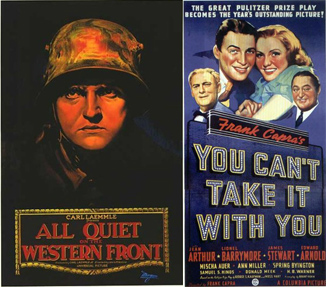
All Quiet on the Western Front (1929/30)

    Possibly the sound era's first great war film and Universal’s first best picture. Most of us probably had to read the Remarque book at some point in our education and maybe you watched this, but you probably got the later remake with John Boy. This is the better film, though that might be a closer adaptation. Not the first “war is hell” movie, but this one really resonated with audiences. The butterfly on the helmet would become an iconic shot for years to come. Not the best war film, but pretty important, if not quite essential. Grade: B+

You Can’t Take it with You (1938)

    A truly delightful film based on the stage play. Frank Capra was at the top of his game here and it is one of the rare comedies to win best picture. It’s a good time. A perfect Sunday afternoon type flick. I like this film, but I feel that Mr. Deeds Goes to Town (even if it wasn’t Best Picture) is more essential Capra. Grade: A-

The Essential

These are films that stood the test of time in their importance and quality. None of these are gonna surprise you and if you are a film buff, these are (like the category says) essential viewing. Though, to be honest, a film doesn’t have to be great to be essential. More on that in a bit.

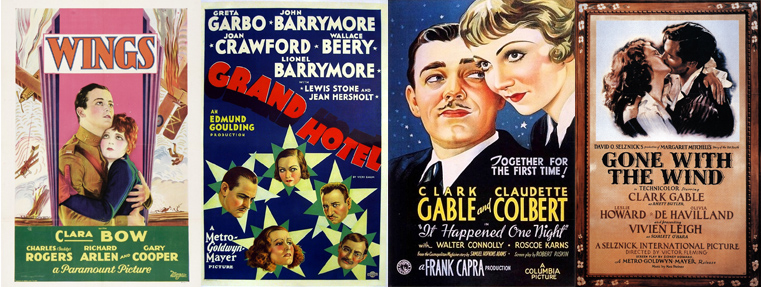
Wings (1927/28)

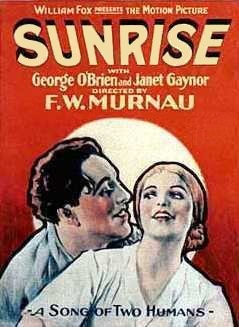
    A silent classic, yes, but is it one of the best silent films? Maybe not. The photography is amazing, the story and the drama are enthralling. It’s worth your time. I’m not sure it stands up to other silent classics of the era, such as Vidor’s The Crowd or Murnau’s Sunrise. Wings has more spectacle than those films, but it doesn’t quite have the artistry of other important silent films. Its position of being the first to win makes it essential, but it is also essential in it would set precedents on the kind of films the Oscars would favor. It is a great early example of the genre of ‘Academy Award.” Grade" B+


Grand Hotel (1931/32)

    I’ll admit, I’m a big fan of ensemble pics. I know they aren’t everyone’s cup of tea, but this is one of the first “seemingly disconnected people in one location” film so it’s worth checking out. That alone makes it essential (at least to me), but the performances and the story are quite exemplary as well- even if it drags a bit. "I vant to be alone" would go down as one of the most quotable lines in film history. I like to think that Robert Altman spent most of his career perfecting Grand Hotel. Grade: B+


It Happened One Night  (1934)

    This is the film all Romantic Comedies aspire to be. If you haven’t seen it, you should remedy that. This won picture, writing, directing, actor, and actress. That didn't happen again until 1975. That's a pretty big deal. It's hilarious and moving, all the great stuff of Frank Capra without all the saccharine. Grade: A


Gone with the Wind (1939)

    Alright, there really isn’t anything I can say about this flick that hasn’t already been said. Is it a bit long? Yeah. Kinda racist? Oh yeah. Is it really that big a deal? I’d say probably so. It’s not a movie that you need to see more than once necessarily, but it’s worth your time if only because so much is derived from it. Also, it actually is a great movie. I don’t know if it is one of the best I’ve ever seen, but to me it is the apex of how great and huge a film can be. Grade: A-

Honorable mention/random note: There were technically two “best picture” winners at the first Oscars. These were “Outstanding” and “Unique and Artistic Picture.” Notice that neither of these are really the definition of the word “best.” “Outstanding” does not necessarily mean superlative, and “Unique and Artistic” means, well, just that. So the first “Best” picture winners were Wings and Sunrise (which is essential viewing by the way, an A+). “Unique and Artistic” only lasted the one year so “Outstanding” would become the “Best Picture” award. Sometimes, I wonder if the Academy would have been stirred a different way if Sunrise was retroactively considered the first winner instead of Wings. Not much of a “what if,” but I get the feeling that films like Citizen Kane and Who's Afraid of Virginia Woolf? may have taken the top prize in their respective years.

Come back Thursday for the 40s!!


Green Room: A Tense Punk Rock Horror Flick Starring Star Trek Guys

I’ve mentioned my horror film credo before (is R-rated, not part of a franchise or remake, not “found footage”), so when I saw the Green Room trailer I obviously perked up. Not only does it check all the criteria, it’s also about a hardcore punk band from DC. Needless to say the horror loving Minor Threat fan in me NEEDED to see this film.

For some reason when I first saw the trailer I got the impression that it maybe took place in the 1980s (ya know, when hardcore was more relevant). It takes place now, but I can’t help but wonder if the first draft of the screenplay originally took place in the 80s, and perhaps it would’ve worked better as a “period piece,” but I don’t really think it matters. A claustrophobic situation, well directed and acted, will work not matter what the time period.

The trailer gives you a pretty good run down on how things unfold: Punks play a venue, see something they shouldn’t, bad things happen. Keeping the action mostly in the small room does heighten the tension, but also brings the film “closer” to our protagonists. This is often the mark of a horror film that is doing more than the bare minimum.  Green Room also deals with a problem horror films must contend with in this day and age: cell phones. The upside of having the plot take place in a skinhead venue- skinheads will break the phone as soon as stuff goes downhill. So that little issue is dealt with quickly, using the plot's own logic.        

The performances are what really make the film shine, though. Using actors the audience are familiar with adds more emotion. I liked all the people in this from other things. Alia Shawkat from Arrested Development and Whip It; Anton Yelchin from the bizarre little horror flicks that could Burying the Ex and Odd Thomas; and of course Patrick Stewart from being Patrick Stewart. This was my first exposure to Imogen Poots, an actress I think can go far.

The story doesn’t waste any time at about an hour and a half. Have I seen something like this before? Oh surely- the “stranger comes to town/town folk aren’t happy” concept is super old in horror (and plots in general), skinheads being the town folk here- but that doesn’t mean you shouldn’t see this. Even if you aren’t a horror fan, I think you will have a pretty great time with this film. Buy the ticket, take the ride. Grade: B+

Additional thought:

I realized something about Patrick Stewart while watching. He doesn’t “Americanize” his voice at all. I don’t know if he ever did really. I mean, when he’s acting around other British actors, he fits in of course, but when he is around American actors his voice doesn’t seem out of place. He doesn’t have a British accent; he has a “Patrick Stewart” accent.

For this film's song pick I just went with Bad Brains’ entire first album.

-Andrew

Source: https://www.youtube.com/watch?v=Q8XSARX3DQ...

A Horror Lover's Credo, The Witch, and the Other Side of the Door

I have this criteria of sorts when it comes to seeing a new horror film in the cinema.

  1. The film is R-rated
  2. The film is not part of a franchise or remake.
  3. The film is not “found footage.”

If the film fits all of these, I at least buy the ticket. Even if I don’t want to take the ride (to borrow from Hunter S. Thompson), I’ll spend the money because it is the kind of horror film that needs support in this day and age. It has become this credo of mine. I’ll be honest though, I always take the ride.

This isn’t to say that these are automatically better films, nor does it say movies that don't fit this criteria are bad. I enjoy found footage flicks from time to time, the occasional sequel, and even PG-13 horror. It isn’t about quality, it’s about encouraging something new.

There’s a new horror flick out now called The Witch (or The VVitch if we want to follow the style). From the trailer I could tell this would fit all my criteria. I finally got around to seeing it the other night and I’m not going to surprise you, I enjoyed it.

The film is like Nick Cave adapting Nathanial Hawthorne. The story is set in puritanical times in New England. It is about an isolated family near the edge of the woods and “strange goings on.” It’s family horror, with a historical twist. Lots of distrust, paranoia, and religiosity. I felt the film did an amazing job with the language of the time. The language makes this more of an “adult” film. I don’t mean that in the Cinemax sort of way, but I think this film is better geared toward adults. Horror is a teenage genre for the most part, but I don’t see this being a big hit with the kiddos. When I was teaching English to freshmen this year, their biggest complaint about Shakespeare and Hawthorne was the language- so I could see this turning them off. Not that there aren’t teenagers that are into this sort of thing. We all knew those 4 or 5 kids who really dug Shakespeare in high school. Still, it’s nice to have a film for adults, regardless of genre.

I might be a little desensitized to horror, so take it with a grain of salt when I say that I wasn’t frightened by this very much. It did give me a good case of the “heebie jeebies,” for lack of a better phrase. No, it didn’t keep me up at night, but that isn’t a mark of its quality. The film is well made in every sense; very well acted, directed, and finely executed. So if you are on the fence about this, I say (to quote Hunter): Buy the ticket, take the ride. Grade: A-

Now sometimes my system doesn’t always pan out. To “walk the walk” this week I also saw The Other Side of the Door. It fits all the criteria, but as I said, those aren’t about quality.

The film is another family horror film or sorts, but with a different focus. An American family living in India lose their son in a car accident. The mother is so distraught she tries to kill herself. Their Indian house keeper tells her of a magic way she can speak to her son to say goodbye, but of course there are rules. The mother, as expected, breaks those rules. The family is then haunted by the dead son and “strange goings on” ensue.

We’ve seen this before, many many times. This “undead son trope” probably goes back before “The Monkey’s Paw.”  I think the film uses the trope effectively, but you can pretty much see what’s coming at any moment. I think horror films about grief are very interesting, so this intrigued me. OSotD owes a lot to Pet Semetary, and there are better films that explore grief in just the last couple of years (The Babadook and The Final Girls). I couldn't help but think of Bob Clark's Deathdream while sitting in the theater. The India setting is neat, but I can’t decide if it is really that important or is it just an excuse to be vaguely racist. I feel like this movie would have worked better if this was 1976.

Despite the flaws, there are things the film does right. We rarely see the undead son, there are a number of set-ups for cliché scares that they don’t follow through on, the mood is fairly spooky, and generally the acting doesn’t suck. Jeremy Sisto, who I’ve been a fan of since Six Feet Under, does a great job even if he seems underused. I’m not sure why this was rated R, though. The violence is no worse than the average AMC show, there is no nudity, and the language is pretty tame.

Basically, it is nothing amazing but I’m sure it will make for a good teenage sleepover viewing in the future. Perhaps not worth the ride, but it’s nice to see something trying to stand-alone. Grade: C-

Here are some songs that got stuck in my head while viewing these flicks:

The Witch

The Other Side of the Door


- Andrew

Reviewing From All Fronts

I’ve known Tim for over 20 years, he was the best man at my wedding and we've been friends since the day we met in 1993. Our love of movies has certainly been one of our strongest bonds and talking about movies has always been a favorite way to pass time. We both like a lot of the same things, but we definitely have our differences.

Read more

The Written Word(s)

We've been talking about movies with each other and our friends (and anyone else who will listen) pretty much forever. We've been doing it in the slightly more formal context of our videos and the website for about a year now. This whole thing is still a bit of an experiment,

Read more